Tuesday, February 26, 2013

Smartphone calculation machines

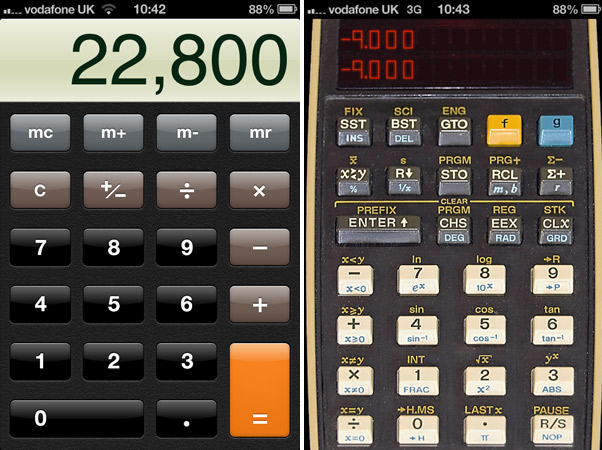
A recent review for an alternative calculator for the iPhone made me consider what people want from a calculator on their smartphone. The calculator is one of those apps which you might not need to use that often but when you need it you are really grateful that it is there (or bitterly regret if it is not!) PopCalc which the Telegraph review looks ok and it is good that some designers are trying to think outside the box and not replicate a physical artefact too deeply though i don't really see a huge amount of benefit over the built in calculator app. Software calculators work pretty well on a phone with a touch screen, i hate using them on a computer using a mouse though.

Interestingly the original iOS calculator took a lot of inspiration from a real-life calculator, the Braun ET44. Nowadays the buttons are square but the calculator app does still look based on one of many calculators which were knocking around in the 1970s and early 80s. Personally i am fine with the built-in app though i do have a RPN calculator (RPN25, below right) as an alternative, its based on the HP-25. It isn't that good but it was free and looks funkily retro. If i'm at home i prefer to use my real HP-12C...

Google makes an example of Interflora

Something odd has happened to Interflora on Google, although a search for that word will come up with third party websites the only official website listed is via a paid advert. It is thought that Interflora are being punished by Google for paying newspapers to publish advertorials. Google does allow paid advertorials but they must use the nofollow tag which were not included in the blizzard of advertorials Interflora paid for in the run up to Valentines's Day. Several UK newspapers have also had their PageRank on Google reduced meaning they do not appear as prominently on Google's results.

Interflora is now trying to get rid of these paid links as fast as they can though the damage to their digital presence may take some time to repair. As well as advertorials in newspapers Interflora also sent freebies to bloggers in return for reviews and a link. However one blogger doesn't think these bloggers are the main cause for Google's reaction but rather something more murky is going on.

We don't get paid for any of our links by the way!

Return to 110 Format photography

A few years ago i bought a Kodak Instamatic off Ebay and took a number of photos in the venerable 110 film format which takes the form of a handy cartridge. Then i dropped the camera in the mud at Plantbrook Nature Reserve and the camera went a bit funny. For a few years i got sidetracked and did not complete my film in that camera but earlier this year i decided to finish the film off (which i was unsure if it still worked or not) and also buy a second Instamatic (a model 91 so older than the other one which is a model 400) and try some new film, made by Lomography no less.

And i got the results back last week. Some of the photos are really pretty interesting. Both cameras work fine (though the older Instamatic sometimes needs coaxing to move onto the next frame) so i will continue to use both in future. The Lomo film was Lomography Lobster Redscale 110 which gives everything a reddy tinge, it also adds a period feel to photos such as the one of Shakespeare's birthplace below, which looks like it might have been taken in the 19th century but in fact was was taken on February 1st 2013! I have a black and white Lomo film ready for use next.

I could of course just use an app like Instagram but where is the fun in that? Well there is fun but its different. In this world of instant gratification there is something nice about taking a photo but not knowing for weeks or months if it actually turned out. Of course this can be annoying when you find the photo turned out a blurry mess.

Monday, February 25, 2013

The virtual keypunch

If you want a taste of "old iron", and classic computing before the days of microcomputers, floppy discs and the like try the Virtual Keypunch. Punched cards were an early data storage method with the data being encoded using holes in a piece of card or other material (hence the need of a Keypunch to make the holes!) Programs were encoded using the cards but because each card (if using the IBM 80 column card method) could only hold one line of code then you might need hundreds if not thousands of cards for a serious program.

All the cards had to be in order and there are plenty of tales of people dropping card stacks. One benefit of this data storage method however was that if you did suffer such a data corruption you could restore it by putting the cards back in order! Corrupted cards (bent for example) could also repunched. By the 1970s computers were moving onto magnetic storage and visual display terminals though you could still find the keypunches and readers well into the 1990s.

Sunday, February 24, 2013

Weapon Fail : Supermarine PB 31E Night Hawk

A new series on weapons that... well... failed. We start off with an aircraft that was in some ways ahead of its time, and ahead of engine technology for sure...

For this first failed weapon we go back to the First World War and the first aircraft to bear the Supermarine name. The company changed had it's name from Pemberton Billing in 1916 (after Mr Pemberton Billing sold his interests to the company's other directors). One of the last aircraft Pemberton Billing had been working on had been the PB 29E, a large quadruplane for anti-airship defence. Unfortunately the sole PB 29E crashed during flight testing but the Admiralty decided to continue pursuing Pemberton Billing's ideas for combating the zeppelin menace so sponsored a further aircraft.


Supermarine PB 31E

This was the PB 31E, like the 29E it was a large quadruplane 37ft (11.27m) long and with a wing span of 60ft (18.28m). It was made more sturdy than the 29E with a planned crew of 5 and heavily armed with a 1½-pdr recoiless gun and twin Lewis machine guns. It was intended to be able to stay aloft for up to 18 hours and carried a searchlight that was powered by a separate engine and thus was probably one of the first aircraft to carry an auxiliary power unit. Because of the long planned duration it was fitted with some basic comforts for the crew including a heated cabin. The aircraft also carried armour in some key areas and the cockpit was bound with fabric to avoid wood splinters in the event of a crash to protect the crew.

The problem with all of these innovative and advanced features was that they weighted a lot! The PB 31E weighed over 6100lb (2787kg) when loaded and there simply wasn't the engine technology at the time to adequately power such a plane. Two 100hp Anzani engines powered the PB 31E and was enough to get it airborne but not enough to give it sufficient performance to perform in the anti-zeppelin role. The PB 31E took an hour to climb to 10,000ft which meant that zeppelins could easily escape it by ditching ballast and climbing rapidly. The design speed had been 75mph (120kph) which was considered fast enough to catch zeppelins (though some zeppelins could go faster than that in favourable conditions) but it is reported the PB 31E struggled to pass 60mph (97kph).


Front view showing the search light on the nose

The PB 31E first flew in February 1917 but by then it was apparent there were flaws in the concept, highlighted by the PB 31E's poor performance. Unable to pursue a zeppelin it's only chance of success would have been the sheer luck of being in the right place at the right time and firing on the zeppelin before it got out of range. It's main armament, a 1½ pounder Davis non-recoil gun, was also rather unwieldy.

The sole PB 31E was scrapped in the Summer of 1917, the second planned example never being built. The PB 31E, which was given the name Night Hawk, was technically innovative and it's concept could maybe have worked with a better performance. It was an early example of what we would call today a "weapons system". In the event the zeppelin was near the end of it's time as a military weapon anyway. Supermarine survived the war, you may have heard of one of their later products...

Further reading :

Supermarine Aircraft Since 1914 (Andrews & Morgan, Putnam, 1981)
Warplanes Of The First World War - Volume 3 (Bruce, Macdonald, 1969)

Friday, February 22, 2013

35 years of football video games

This great video collects together dozens of snippets from football video games showing how the beautiful game has evolved in the world of computer games, ranging from Football in 1978 to last year's FIFA 13.

International Space Station - Haynes Manual (Book Review)

For years Haynes manuals were synonymous with home car repairs and workshops but in recent times they have applied their iconic design and approach to other topics too and they are among my favourite books these days.

Haynes manuals are excellent value books full of accessible information, their book on the development of the International Space Station is no different. Starting with Mankind's earlier attempts at permanent space stations through to the Mir the book then describes how the ISS was built up piece by piece and what every module does.

Missions to the ISS are also described and listed chronologically as the ISS was developed up until 2011. The number of nationalities who gone up to the ISS is very interesting and helps to show how little the ISS is mentioned in the mainstream media as everything genuinely goes very smoothly (things do go wrong occasionally) . Obviously the success of the ISS is a good thing but its a shame it is not written about more.

This wonderful book helps readdress the balance and is highly recommended. It has been written by Dr David Baker who worked for NASA for 25 years including time on the Gemini, Apollo and Shuttle programmes. For a video tour of the ISS see here.